


A Biblical Case Study:
The Sufficiency of Christ’s Righteousness vs. "Another Gospel" – Stewardship, Early Apostasy, and the Timeless Warning of Galatians 1
Over the years in my devotions and posts, one thing has always stood out to me, I've always had an appreciation for genuine ecumenical spirit.
I work shoulder-to-shoulder with Roman Catholic brothers and sisters, United Methodists, Baptists, Presbyterians, non-denominational folks, and many others. In the Kairos prison ministry especially, we all make an intentional effort to focus on "common ground", the core truths we share about Jesus Christ. This is beautiful and it matters to us.
At the same time, those good ecumenical ideals sometimes rub up against each other when we get into the deeper doctrines. It can challenge our feelings of unity. But here’s the thing we’ve lived out, we’re still willing to come together and labor as one for the gospel of Jesus Christ, evangelizing with the truth of that gospel. And because we love people and love the Lord, we can’t be ashamed or afraid to speak that truth plainly and stand firm in it.
That’s exactly why this case study matters. My conviction has remained rock-solid.
Christ’s righteousness is sufficient.
Period.
No additions.
No institutional upgrades.
No "all we can do" qualifiers layered on top.
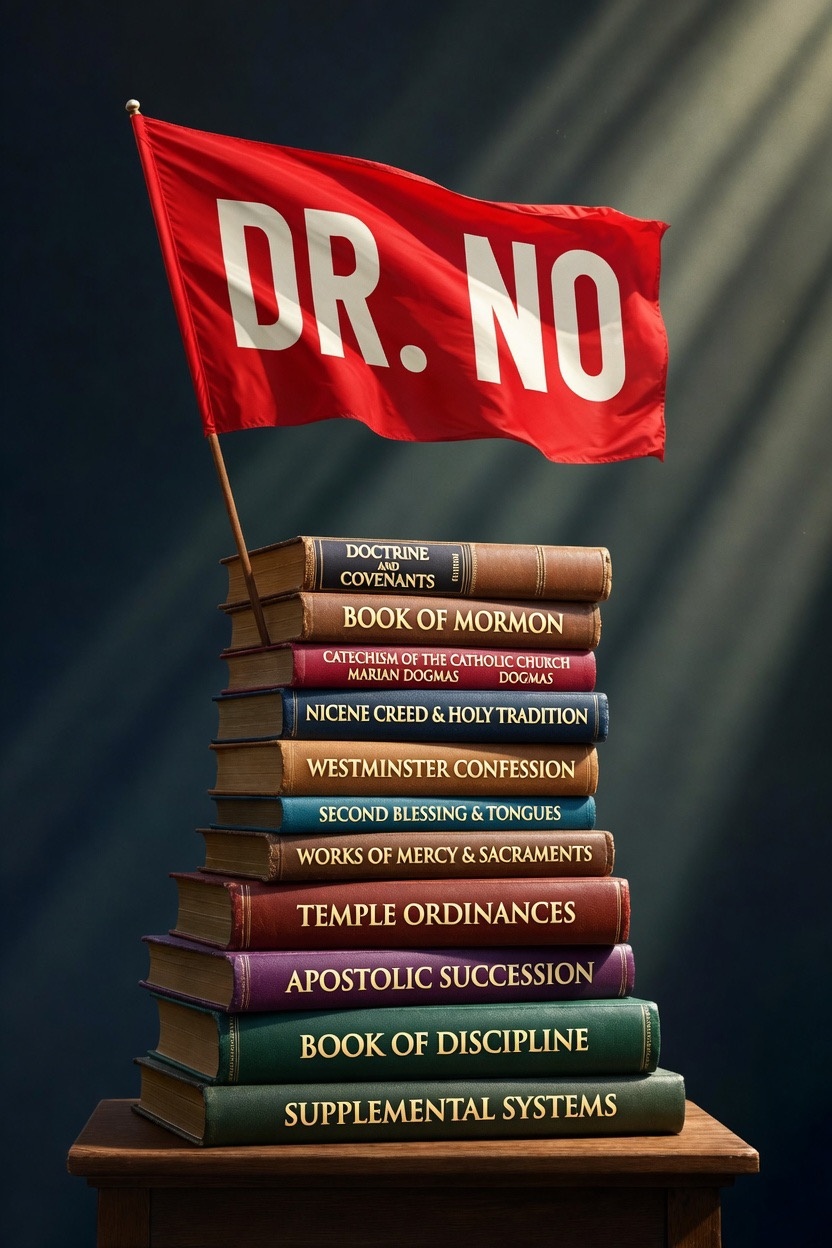
I call this my "Doctor No" stance. A clear, unwavering No to anything that muddies up the pure gospel of grace through faith in Christ’s finished work.
It’s not harshness or division for division’s sake; it’s fidelity to Scripture, spoken in love.
1. The Parable of the Talents:
What the Master Actually Requires
Jesus tells the story (Matthew 25:14–30) of a master who freely entrusts his servants with talents before leaving on a journey. Two invest and multiply what they received; one buries his out of fear. The reward is for the faithful stewards:
"Well done, good and faithful servant…enter into the joy of your master."
The failure is unfruitful inaction.
The "works" that matter are actively stewarding and multiplying the simple gospel itself, not adding layers of institutional requirements or meritorious acts.
2. 2 Timothy:
The Pattern of Departure Was There from the Start
In my current readings in 2 Timothy, Paul’s final letter shows the painful reality of desertion and distortion happening even in the first century. This isn’t proof of a total apostasy needing a later restoration, it’s the ongoing mess we still see today.
My "Doctor No" lens, which is shaped by years of ministry across denominational lines, sees this clearly. We test everything against the apostolic deposit found in Scripture, even while we lock arms with fellow believers on the essentials.
3. Galatians 1:6–9
The Non-Negotiable Red Flag
Paul’s strong words here are impossible to soften:
Even if an angel from heaven preaches a different gospel, let him be accursed. This warning hits every tradition that layers on extra requirements.
4. Specific Claims Across Traditions, and How They Address Galatians
We see this played out in several major traditions, each with sincere arguments for why their additions don’t violate Galatians.
Latter-day Saints: Official Church manuals directly tackle Galatians 1:6–9. They argue that Paul was only condemning the 1st-century Judaizers who added circumcision and law-keeping as requirements for justification. The Restoration, they say, is not "another gospel" but the original gospel restored in its "fulness" after the Great Apostasy. They point to Revelation 14:6, the angel flying with the "everlasting gospel", as prophecy fulfilled by Moroni and other angelic messengers who brought the Book of Mormon. The Book of Mormon is called "Another Testament of Jesus Christ", a continuation and second witness, not a different gospel. It restores "plain and precious truths", saving ordinances, temple covenants, and the "fulness" that was supposedly lost for nearly 2,000 years.
In their view, Joseph Smith received secret knowledge and authority that completes what the apostles had only partially.
Roman Catholic Church: The Catechism teaches that the sacraments are "necessary for salvation" as the ordinary means of grace (CCC 1129). Salvation is synergistic, faith plus good works plus full participation in the seven sacraments under the authority of the Magisterium (the Pope and bishops teaching infallibly). Sacred Tradition is placed on equal footing with Scripture. Marian theology adds significant additional layers and emphasis. Dogmas such as the Immaculate Conception, the Perpetual Virginity of Mary, her Assumption into heaven, and her role as Mediatrix and Co-Redemptrix in popular devotion. These are all presented as developments of apostolic faith, protected and defined by the Magisterium, not as contradictions to the gospel but as fuller expressions of it.
Eastern Orthodox Tradition: Salvation as theosis (becoming partakers of the divine nature) is lived out through the Holy Mysteries (sacraments) and the full liturgical life of the Church. Apostolic succession and Holy Tradition are indispensable; human cooperation with divine grace is required for full union with Christ.
Other Denominational Doctrines: Across various Protestant, Arminian, Wesleyan, charismatic, or restorationist groups, we often see meritorious acts of faith, "second blessings", speaking in tongues as necessary evidence, specific works of mercy, or certain disciplines elevated as co-conditions for final salvation or as the means of "restoring" a supposedly incomplete or apostate church.
In our Kairos work and other shared ministry, we focus on the beautiful common ground; the cross, the resurrection, salvation by grace. But when those other layers (whether restored ordinances, sacramental necessity, Marian dogmas, Magisterial authority, or required meritorious acts) are taught as necessary for full salvation or exaltation, that’s where the ecumenical spirit meets the clear line Paul drew in Galatians.
5. Backing my "Doctor No" Stance: Why These Claims Do Not Hold
My Position, that Christ’s righteousness is fully sufficient without any supplemental human effort, institutional ordinances, sacraments, Marian dogmas, Magisterial additions, or meritorious acts; stands squarely on Paul’s own words and the consistent New Testament witness.
Here is the direct biblical pushback that applies across all these traditions:
• The distinction between "continuation", "development,” "restoration", or "necessary expressions of faith" and "another gospel" collapses under Galatians.
Paul’s curse targets any distortion that shifts justification away from faith in Christ’s finished work alone (Galatians 2:16; 3:1–14). The simple gospel he preached; Christ died for our sins, was buried, rose again, received by grace through faith (1 Corinthians 15:1–4; Ephesians 2:8–9), needs no supplements, no matter how ancient, well-intentioned, or sincerely defended.
• The "secret/lost knowledge", "institutional fulness", Magisterial authority, or Marian dogmas claim after centuries is especially weak. It assumes the Holy Spirit was unable to preserve or transmit the essential saving truths until later messengers, councils, or developments supplied what was missing. This contradicts the apostles’ testimony:
• Jude 1:3 — The faith was delivered "once for all" to the saints.
• John 16:13 & 14:26 — The Holy Spirit would guide the apostles into all truth.
• 2 Timothy 3:15–17 — Scripture thoroughly equips the believer for every good work.
�Jesus promised the gates of Hades would not prevail against His church (Matthew 16:18). And the pattern in 2 Timothy shows distortion happens within the visible church through human failure, not a total loss requiring later upgrades.
• Revelation itself forbids the additions. The same book cited for the "angel with the everlasting gospel" (Revelation 14:6) closes with this warning:
"I warn everyone who hears the words of the prophecy of this book: If anyone adds to them, God will add to that person the plagues described in this book…" (Revelation 22:18–19).
The "everlasting gospel" is unchanging; not upgraded, restored, or completed by later revelations, traditions, dogmas, or systems.
The Parable of the Talents calls us to multiply what the Master has already given, not to invent new mechanisms or add required works. And 2 Timothy shows the pattern of desertion and myth-turning was already happening while the apostles still lived. Galatians 1 plants the red flag that has never been taken down. My "Doctor No" reads these texts plainly:
Guard the deposit (2 Timothy 1:13–14) against any "different gospel", no matter how sincerely presented, how ancient the tradition, or how many angels, councils, or good works are invoked.
This isn’t about rejecting sincere believers in any tradition; Catholic, LDS, Orthodox, or otherwise. In our Kairos ministry you live this out daily. Loving people across every line while holding fast to the truth.
It’s about loving them enough to point back to the simple, sufficient righteousness of Christ. We can rejoice in that common ground and still speak the truth in love.
The Bible doesn’t equivocate.
Neither should we.
We must pressing into 2 Timothy and Galatians. And keep doing the beautiful Kingdom work in Kairos and beyond. Loving people across every line while holding fast to the truth. The Lord who stood with Paul stands with us.



![DeSantis Making Moves to Abolish Property Taxes, But Has Bad News For New Yorkers [WATCH]](https://www.lifezette.com/wp-content/uploads/2026/05/2026.05.03-02.12-lifezette-69f757b1f3ce6.jpg)